

Prix Mobilière
2027 Prix Mobilière
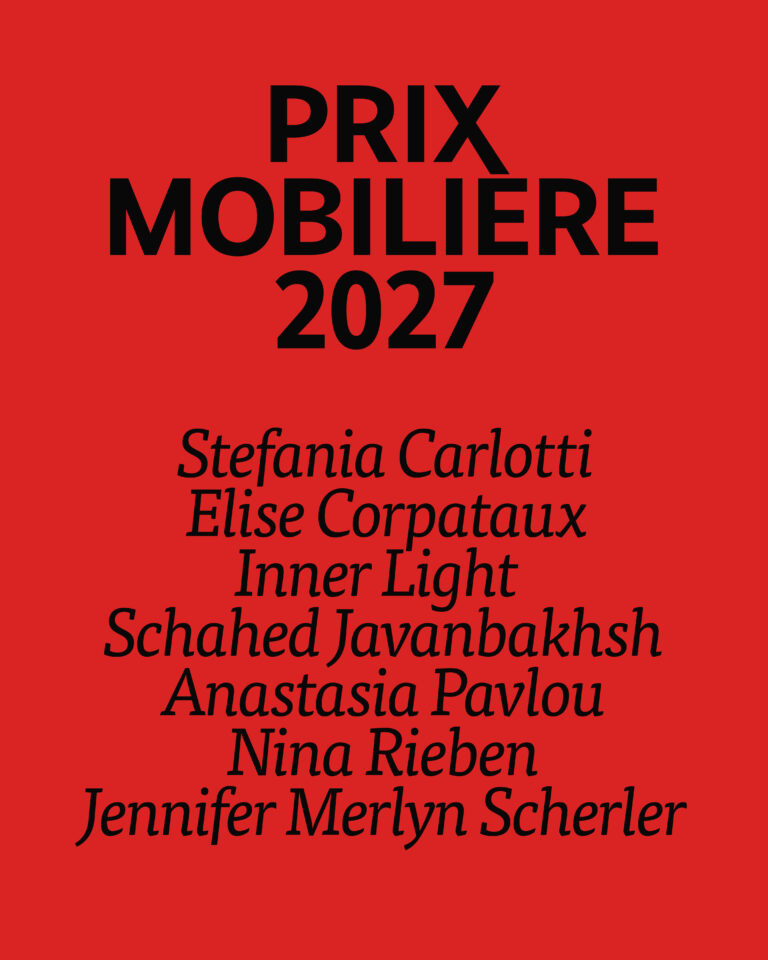
The artists nominated for the 2027 Prix Mobilière represent contemporary happenings in the Swiss artistic landscape.
They use different forms of expression to question key issues of our time. More information about the artists nominated can be found here.
The nomination committee
Andrea Bellini
Director, Centre d’Art Contemporain Genève
Fanny Hauser
Director, Kunsthalle Zürich
Stefanie Gschwend
Director, Kunstmuseum / Kunsthalle Appenzell
Niklaus Güdel
Director, Musée de Pully and Fondation Ferdinand Hodler, Geneva
Yves Netzhammer
Artist, Zurich
Giada Olivotto
Freelance curator and co-director of Sonnenstube, Lugano
Marlene Wenger
Programme Manager, House of Electronic Arts, Basel
The nominees
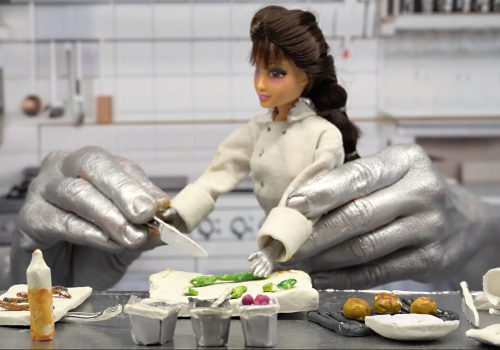
Stefania Carlotti (*1994, lives and works in Switzerland, France and Italy)
“Stefania Carlotti’s artistry resembles a contemporary cowgirl figure galloping through capitalism in search of artefacts rooted deeply in the collective imagination. Objects, details and forms of popular culture are collected, reproduced and transformed until they lose their original function and develop new narrative potential. Carlotti uses precise, ironic and wild feminine aesthetics to scrutinise the boundaries between consumption and desire, acquisition and production. Sparkling nail polishes, sumptuous cake icings, high heels, pop tunes and rearing horses are used as tools to create spaces of recognition and possibility. Rather than rejecting contemporary codes, she rides on them and reinvents them. This gives rise to distinct forms of expression and resistance.”
Giada Olivotto
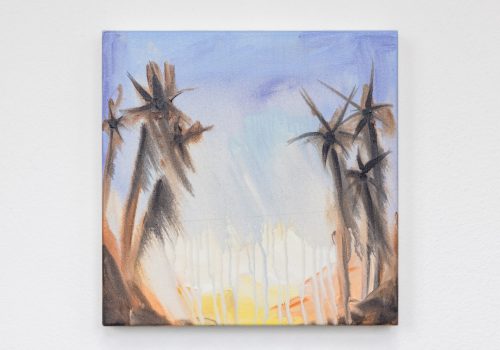
Elise Corpataux (*1994, lives and works in Fribourg)
“Elise Corpataux studied at the University of Art and Design Lausanne (ECAL) and the Basel Academy of Art and Design. She belongs to a generation of artists placing the imaginary back at the heart of their work. Based on childhood memories, she casts a slightly crazy glimpse on the world. Her work revolves around nostalgic emotions that have shaped her in her career: being in love, longing for oneself and for others, the idea of a deliberately kitschy America. In her pointedly bizarre figurative paintings, Elise Corpataux openly confesses her subjugation to cinematic and artistic influences and cites Jenny Holzer, Ed Ruscha and Nan Goldin. Sunsets, kisses and moments of reflection evoke a specific form of the innocence typical of the 1990s with ostentatious nonchalance. Her simultaneously gestural yet geometric technique with its joy in combining is reminiscent of collages. Elise Corpataux sees her painting as a contemporary renewal of figurative art. With subtle irony, she directs our gaze towards what distinguishes us as humans. In an increasingly unsettled world, this distance appears essential in order not to forget how to dream.”
Niklaus Güdel
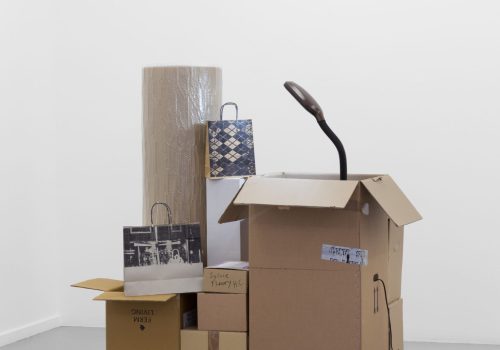
Inner Light (*2018, Geneva collective; key members: Kim Coussée (*1994), Eliott Villars (*1995), Gaia Vincensini (*1992))
“Inner Light is a Geneva-based collective of artists intelligently and courageously gauging the interfaces between contemporary art and fashion. With a hybrid practice of performance, textile design and installation, the collective has developed a unique visual language in which clothing becomes both an artistic medium and a narrative element. The works deal with identity, transformation and perception and create immersive experiences that rethink and extend conventional exhibition formats.
A characteristic feature of Inner Light is its ability to integrate spaces and bodies in equal measure, thereby producing vivid and frequently collaborative works that directly involve the audience. Its artistic approach stands as an example of transdisciplinary work and new forms of collective creativity.
The nomination of Inner Light for the 2027 Prix Mobilière is in support of an innovative, inclusive and resolutely contemporary artistic vision that takes effect in the most diverse cultural contexts and redefines the established interdisciplinary boundaries.”
Andrea Bellini
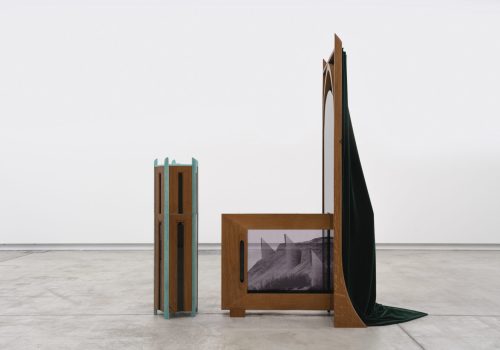
CATALOGUE, Centre d’Edition Contemporaine, Geneva, 2026. Pictures by Thea Giglio
Schahed Javanbakhsh (*1993, lives and works in Zurich and Copenhagen)
“Schahed Javanbakhsh is an artist who focuses on systems of meaning: systems of meaning that do not indoctrinate while also not being easily accessible. He shapes his sculptures using old techniques and contemporary devices that allegorically illustrate parallel narrative levels through their mechanisms and materiality. His work pulsators comprises a solid wooden stencil that strokes a bell made of perforated steel and dusts it at an imperceptible speed, thereby generating moiré patterns when viewed while moving and a simultaneous dead spot disrupting all wireless technologies in the room.
With remarkably precise craftsmanship, Javanbakhsh conveys a sincerity, a new identity or even a new meaning upon the assembled elements. Through the careful observation of real-life situations and boundaries between objects and their surroundings, he transforms both the perceived and the historical in an autonomous manner. This results in sculptures with layered memories. Or to put it better: it results in sculptures that trigger memories and yet have something to do with the future.”
Yves Netzhammer
Anastasia Pavlou (*1993, lives and works in Athens and Basel)
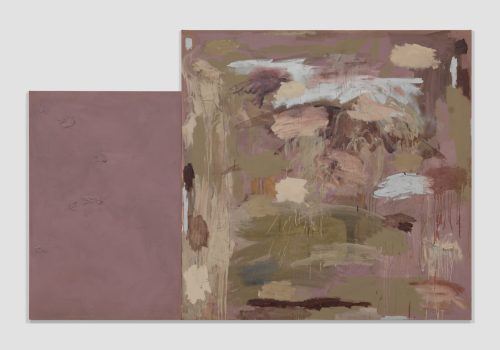
“The image in the end is not something that was made, but more something that happened,’ says Anastasia Pavlou, thereby referring to the contingent (spatial, temporal and institutional) conditions surrounding a work of art and forming part of its essence. She develops her works over long periods of time on the floor and integrates found materials collected in her studio into the canvas. None of this is determined in advance or specifically selected for a particular composition: procedure, duration and coincidence are inscribed in the image.
Anastasia Pavlou moves between painting, drawing and photography and views collage as both a method of image production and a conceptual framework. She thus transcends the art-historical script of painting and draws on the dramatic resources of the theatre, the narrative structures of literature and the spatial strategies of sculpture and installation. Frequently created as polyptychs to be read more as chapters than as isolated image areas, her works conceive the image as an open field. This causes Pavlou’s practice to continually raise fundamental questions: where does painting actually take place? How is an image created?”
Fanny Hauser
Nina Rieben (*1992, lives and works in Bern and Basel)
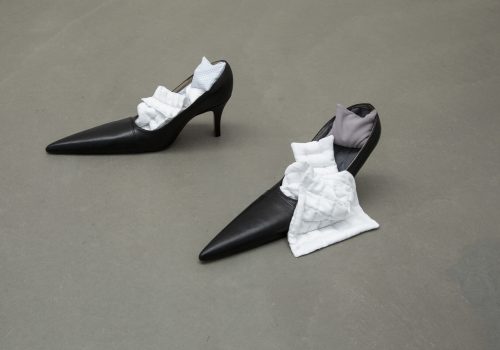
“In Nina Rieben’s works, the image rarely begins where it is visible. It develops interstitially: between text fragment and everyday object, between the black background of a photograph and a fleeting trace of light, between yearning and the suspicion of verging on the ridiculous. Rieben does not enact complete narratives, but precarious situations. Shoes, items of clothing, cigarettes or smartphones appear as the subjects of an experience that can never be completely deciphered. Therein lies, for me, the precision of her art: the casual and the sensual converge without coming undone. A subtle irony pervades these constellations and prevents their poetry from being reduced to pathos. The installations keep the view in motion, allow things to behave as if they had a memory and reveal unexpected connections between them. Projections, traces and gaps form a reality that always remains provisional in Rieben’s concept of ‘unstable sensuality.”
Stefanie Gschwend
Jennifer Merlyn Scherler (*1996, lives and works in Basel)
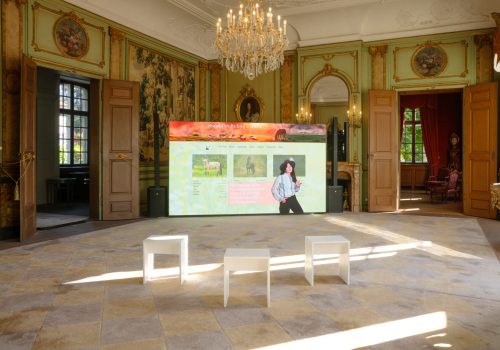
“Jennifer Merlyn Scherler has developed an analytical-performative approach that examines the fringes and depths of web-based platform capitalism and investigates how the present is processed there. She confidently masters the grammar of contemporary internet culture and combines its aesthetics with ancient cosmologies. Formats such as music clips, reality TV and fan culture through to the most bizarre social media trends are reproduced with their own narratives and staged with remarkable precision. For Scherler, this gesture is not just skilful appropriation, but is coupled with a cultural-historical level comprising contextualising, theoretical knowledge presented by the characters of the works themselves, who are partially inspired by mythology – a kind of TED Talk in drag. What I find fascinating about Scherler’s work is the clarity with which she captures super-specific online niche phenomena, understands their nuances and adopts them as her own. Her work displays humour without lapsing into the purely ironic and exemplifies vehemence and seriousness without taking itself too seriously.”
Marlene Wenger
Award winners
The 2026 Mobilière Prize was awarded to artist Cassidy Toner.
Alfatih
2025 award winner
Deborah-Joyce Holman
2024 award winner
Jan Vorisek
2023 award winner
Romane de Watteville
2022 award winner
Miriam Laura Leonardi
2021 award winner
Matthieu Barbezat et Camille Villetard
2020 award winners
Maya Rochat
2019 award winner
Julian Charrière
2018 award winner
Bertold Stallmach
2017 award winner
Vittorio Brodmann et Mathis Altmann
2016 award winners
Raphael Hefti
2015 award winner